
Our Approach

The Problem With Most Resilience Training
Most resilience and crisis preparedness programs are built around content delivery. An expert presents information. Participants listen, take notes, and receive a certification. The organization files the certificate. Eighteen months later, a real incident unfolds — and the performance looks nothing like what was taught in the classroom.
This is not a content problem. Organizations generally have access to good information about crisis management, resilience, and safety. The problem is that knowing what to do and doing it under pressure are two different capabilities. Content delivery builds the first one. It cannot build the second.
Resilience is not a concept you understand. It is a behavior you practice — until it holds when everything else is falling apart.
The STOSAIC Answer: Problem-Based Learning
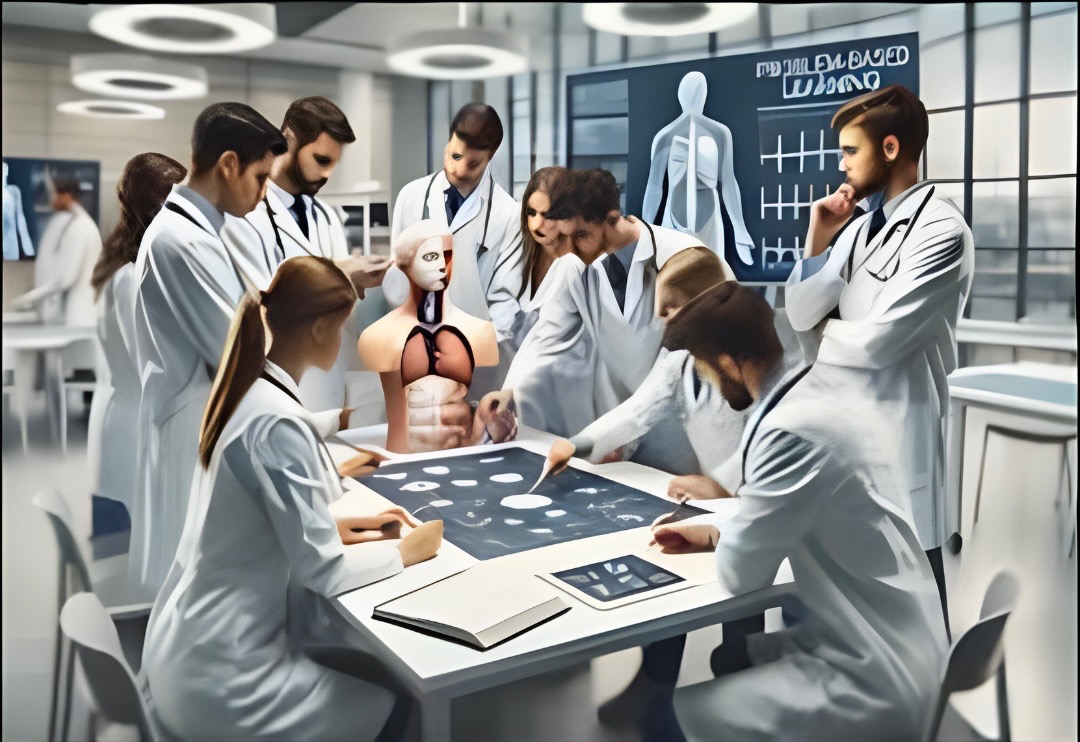
STOSAIC’s delivery model is built on Problem-Based Learning (PBL) — a methodology with deep roots in medical education, military training, and high-stakes professional development. The core principle is this: people build durable behavioral capability when they are placed inside realistic problems and required to navigate them, not when they are told how to navigate them in the abstract.
In a STOSAIC engagement, participants work through scenarios drawn from real operational contexts — their industry, their role, their specific pressure points. Facilitators observe behavior, not just outcomes. The debrief surfaces what participants actually did under pressure, not what the curriculum said they should do. That gap — between practiced behavior and expected behavior — is where STOSAIC’s real work begins.
The result is not a certification. It is a documented behavioral baseline, a set of practiced responses tested under simulated pressure, and a measurement framework that tracks change over time. That is what transfers to the real environment.
The Seven-Competency Framework
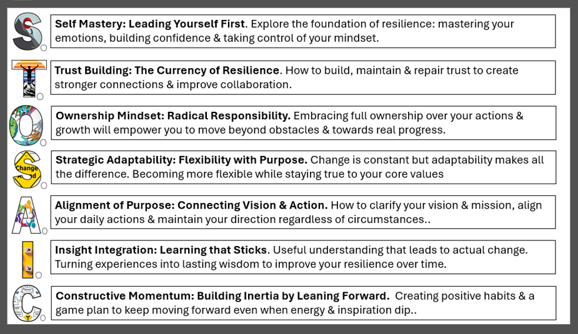
STOSAIC’s Scope 1 engagements are organized around seven observable competencies that research and operational experience identify as the behavioral predictors of individual and team performance under pressure. These competencies are not attitudes or mindsets — they are behaviors that can be observed, measured, and developed through deliberate practice.
Self-Mastery is the capacity to regulate one’s own cognitive and emotional state under pressure. Trust Building is the ability to establish credible, reliable relationships that hold during high-stress conditions. Ownership Mindset is the behavioral pattern of taking full accountability for outcomes rather than deflecting to circumstance. Strategic Adaptability is the capacity to shift plans and approaches when conditions change, without losing orientation to the goal. Alignment of Purpose is the ability to connect daily action to organizational mission in ways that sustain motivation through adversity. Insight Integration is the capacity to synthesize information rapidly and apply it to decisions. Constructive Momentum is the ability to keep teams moving forward productively even when conditions are unclear or adverse.
Each competency is assessed at baseline, developed through scenario-based practice, and measured post-engagement. This is what separates STOSAIC from a training vendor: we do not assume the training worked. We measure whether it did.
What a STOSAIC Engagement Looks Like
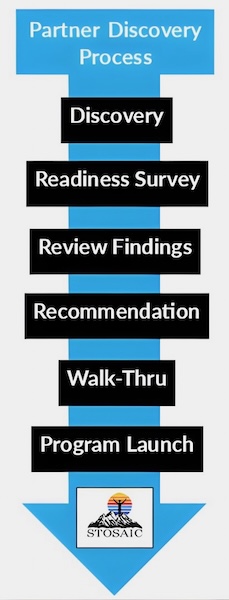
Every STOSAIC engagement is customized, but the architecture is consistent. We begin with a discovery conversation to understand the specific pressures your organization faces, the outcomes you need to produce, and the behavioral gaps that are costing you performance. We design scenarios drawn from your operational context — not generic case studies from unrelated industries. We deliver through facilitated workshops or Mosaic Labs that put participants inside problems rather than in front of presentations.
We debrief with behavioral precision, not general feedback. We measure what changed and what did not. We return to close the loop. And we build internal facilitator capability so your organization is not permanently dependent on external consultants to maintain the gains.